Most fire drill leaders are not underperforming.
They are operating inside compressed time horizons.
Urgency replaces direction.
Speed replaces clarity.
Activity replaces alignment.
Execution without strategy creates motion — not momentum.

Strategic leadership is not a personality trait. It is a discipline. And disciplines can be built.
This guide introduces a practical way for HR and L&D leaders to build that discipline intentionally.
Want to talk it through?
At Talent Praxis, we help organizations define and embed leadership competencies that actually get used—through coaching, training, and system design.
If you’d like help adapting this approach to your organization, let’s talk.
Start With Purpose: Anchor Leaders in “Why”
Strategic leadership begins with clarity.
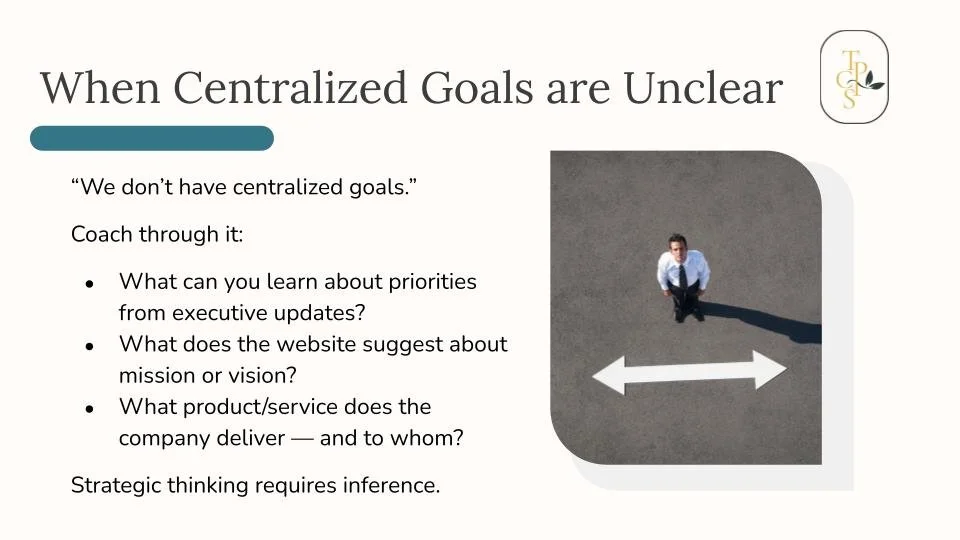
Leaders must know — or intelligently infer — company priorities and clearly articulate the role their team plays in advancing them.

If a leader cannot answer:
Why does this team exist?
How does this initiative support company priorities?
What long-term goal does this advance?
They are likely managing activity rather than positioning impact.
Using Simon Sinek’s “Start With Why” as a coaching structure helps elevate conversations from execution to contribution.
Purpose becomes a decision filter.
It clarifies trade-offs.
It shapes priorities.
It reframes conversations.
Without purpose clarity, leaders default to urgency.

Expand Perspective: Surface Strategic Forces
Clarity of purpose is necessary — but not sufficient.
Strategic leadership also requires awareness of the environment shaping performance.
Using Porter’s Five Forces as a questioning tool, leaders can examine:
Who relies on the output of this work? (buyers)
What are we most dependent on for success? (suppliers)
What substitutes exist?
What structural shifts could impact our success?

These questions shift leaders from managing internal tasks to understanding positioning, leverage, and risk.
At the team level, this means:
Strengthening key buyer relationships
Intentionally managing supplier dependencies
Anticipating automation, outsourcing, or structural shifts

Strategic leaders do not resist change. They anticipate it, adapt early, and optimize it.
Translate Insight Into Practice
Insight alone does not produce strategic leadership.
Practice does.
HR and L&D leaders can embed strategic thinking by reframing everyday conversations.
Instead of:
“How are things going?”
Ask:
How is this aligned to your team’s purpose?
How does this initiative support company priorities?
Who relies on the output of this work?
What are you most dependent on for success?
If you approached this differently, what could that look like?
What structural shift could impact your success?
These questions elevate the altitude of leadership conversations in real time.
Strategic behavior follows strategic questioning.
Embed It Into Existing Leadership Rhythms
You do not need a new initiative.
Embed this discipline into:
1:1 coaching conversations
Quarterly planning
Talent reviews
Succession discussions
Leadership workshops
Strategic thinking becomes cultural when it becomes habitual.
Your role is to inspire strategic thinking by building clarity, expanding perspective, and embedding disciplined questioning.
Leaders must step into it.
The Foundation for Strategic Leadership
Strategic leadership rests on three elements:
Purpose — clarity on why the team exists and how it advances company priorities.
Perspective — awareness of the strategic forces shaping performance.
Practice — disciplined thinking that turns insight into behavior.
This is the foundation.
When HR and L&D leaders build this foundation, they create the conditions for leaders to move beyond urgency and lead with intention.
Want support applying this?
At Talent Praxis, we partner with organizations to embed disciplined strategic thinking into leadership development — through coaching, training, and leadership system design.
If you’re ready to move beyond reactive leadership, let’s connect.